Authors: Niamh Hughes & Samuel Adebayo, PhD
Published: ISx4 • AI Research – 2025
Download PDF
Executive Summary
Agentic workflows are advanced AI-driven processes that can plan, decide, and act through multiple steps autonomously. In essence, an agentic workflow combines large language models (LLMs) with tools and feedback loops to manage tasks independently, freeing humans to focus on higher-level decisions. Unlike a single-turn AI response, an agentic system involves an AI agent that reasons through problems, selects and uses external tools, adapts its plan based on outcomes, and completes a sequence of sub-tasks with minimal human guidance.
This white paper introduces agentic workflows and how to deploy them without the drama – i.e. with reliability, transparency, and control. We discuss the benefits and challenges of running AI agents in production, outline the anatomy of an agentic system, provide a legal use case, and compare internal (employee-facing) versus customer-facing agents. Finally, we conclude with practical advice and a call to action for partnering with ISx4 to implement these solutions with proper governance.
Benefits of Agentic Workflows
Modern AI agents can coordinate complex tasks in ways traditional automations cannot. Key benefits include:
- Autonomy and Adaptability: Agentic workflows operate with goal-driven autonomy. They dynamically adjust to new inputs or changing conditions, rather than following a rigid script.12 This flexibility means an agent can handle evolving situations or unexpected challenges by recalculating its actions in real time, staying aligned to its goal.1 Where a static workflow would break, an AI agent can learn and adapt, leading to more robust performance.
- Improved Complex Task Performance: By breaking down complex jobs into manageable steps (a process known as task decomposition), agentic systems often outperform one-shot approaches on difficult tasks.2 The agent "thinks" through a multi-step plan before acting, which can reduce errors and yield higher-quality results.3 This multistep planning enables higher quality outputs in areas like coding, writing, or data analysis.
- Continuous Learning and Self-Correction: Agentic workflows can incorporate feedback loops to improve over time. Many agents use a reflection or review step to critique their own output and refine it.1 They also maintain memory of prior interactions and results, enabling learning across sessions. This means the agent can avoid repeating mistakes and get better with each iteration.24 In enterprise settings, this self-optimisation translates to growing efficiency and accuracy as the system handles more cases.
- Operational Efficiency at Scale: When implemented correctly, AI agents can handle routine or high-volume tasks faster and with less manual effort. They excel at automating repetitive workflows (e.g. updating records, routing queries) with minimal oversight.1 By offloading drudge work to agents, organisations boost overall productivity. Studies have found that autonomous AI systems with feedback loops increased process efficiency by 35% and sped up decision-making by 20% within months.4 Moreover, agentic workflows can scale elastically – multiple instances or specialised sub-agents can run in parallel – allowing enterprises to tackle larger workloads without linear increases in staff.
Of course, these benefits only materialise if agents are built right. A poorly designed agent could flounder or even introduce new problems.
Challenges of Deploying AI Agents (and How to Mitigate Them)
While promising, agentic workflows come with practical challenges that must be managed to avoid "drama" in production:
- Increased Complexity and Unpredictability: Giving an AI more autonomy also adds uncertainty. Unlike a hard-coded workflow, an agent may take an unexpected path or output, since its decisions are often probabilistic.5 This can reduce reliability if not properly constrained. The solution is to add guardrails and limits on the agent's actions – define allowed tools, set role boundaries, or require the agent to get approval for high-stakes steps. As a best practice, start simple: do not use an agent where a straightforward script suffices.56 Reserve agentic approaches for problems that truly need adaptive decision-making and keep the agent's scope as narrow as possible.
- Error Handling and Safety: In a multi-step agent run, many things can go wrong – an API call might fail, the model might hallucinate a step, or the agent might get stuck in a loop. Robust error handling is critical. Agents should be designed to fail gracefully: for example, by catching exceptions and trying an alternative strategy or reverting to a safe state.7 If the primary language model is unavailable or produces an error, the agent can automatically switch to a backup model or a predefined contingency plan.7 Additionally, human-in-the-loop checkpoints can be inserted for oversight on critical decisions.
- Latency and Efficiency: An agentic workflow often involves multiple LLM calls and tool invocations, which can introduce latency. Many AI agents trade off speed for better results,8 but in customer-facing scenarios, long waits are unacceptable. To mitigate this, teams focus on optimisation: measure and trace the agent's execution to find bottlenecks, then streamline. For instance, calls could be batched or run in parallel to cut response time.7 Using a more efficient model for certain steps or caching frequent results are other tactics to reduce latency. Careful prompt design can also avoid unnecessary loops.
- Observability and Auditability: Building trust in an autonomous agent requires making its behaviour transparent. Without good observability, an AI agent is a black box – if it takes a wrong turn, it's hard to diagnose why.9 For enterprise-use and especially in regulated industries, it’s crucial to log what the agent did and why, so that you can audit its decisions. Teams should implement tracing for each agent execution: recording prompts, model outputs, tool calls, and intermediate reasoning steps.10 Modern LLM observability tools represent an agent's run as a trace composed of spans, where each span is a step like an API call or LLM response.1011 This rich telemetry turns the "black box" into a "glass box". Observability is not a nice-to-have – it's essential for debugging, cost monitoring, and safety in production.11
- Governance and Control: An autonomous agent might have access to sensitive data or be allowed to execute transactions, which raises governance questions. It's important to limit the agent's privileges to the minimum needed for its tasks and to enforce policies at multiple levels. Tool usage can be sandboxed, all actions should be permissioned and logged, and human override mechanisms are key. Mature agent frameworks include features for output validation, decision overrides, and human-in-the-loop checkpoints out of the box.12
By acknowledging these challenges and designing accordingly, one can deploy agentic workflows that are reliable, observable, and safe. The goal is to reap the benefits of autonomous AI without the drama of ungoverned behaviour.
Anatomy of an Agentic System
A Planner module breaks down goals into tasks. The Executor carries out each task, often by calling external Tools (APIs, databases, etc.). The agent uses Memory to store context and results, enabling it to maintain state across steps and learn from feedback. A Feedback loop connects back to the planner, allowing the agent to adjust its plan based on outcomes before the process repeats or terminates.
Underneath the buzzword "agent" lies a modular system of coordinated components. An agentic workflow can be viewed as an AI orchestrator that integrates several building blocks to achieve autonomy.13 The core components include:
- Planner: The planner is the strategic brain of the agent. It takes a high-level goal or request and decomposes it into a sequence of actionable steps.13 For example, if the goal is "analyse this contract and draft a summary", the planner might produce a plan: (1) extract key clauses, (2) check each clause against compliance rules, (3) summarise findings, (4) compile a report. A good planner is dynamic – it can adjust the task list on the fly if new information arises or if certain steps fail.13 This component injects goal-oriented decision-making into the workflow.
- Executor: The executor is the hands of the agent – it carries out the tasks the planner specifies.13 Often the executor is an LLM itself (instructed to perform a specific subtask) or a controller that calls various functions. It interfaces with external systems to do the work: querying a database, calling an API, drafting text via the LLM, etc. In advanced setups, the executor can spawn sub-agents or parallel processes for efficiency.13
- Tools and Integrations: No agent is an island; useful agents leverage external tools to extend their capabilities.14 Tools could be anything from a web search API, a calculator, a database, an internal CRM system, to even another ML model. By calling tools, the agent can retrieve up-to-date information and take actions in the real world. Tool-use is often orchestrated by the executor. A robust agentic framework provides a library of tool integrations and a standardised way for the agent to invoke them (for example, via the emerging Model Context Protocol standard14). However, each tool call is also a potential point of failure.
- Memory (Context Storage): Memory is the agent's contextual glue. Unlike a stateless API call, an agent carries state across multiple steps – it "remembers" what has happened so far.15 This could include the conversation history with a user, the intermediate results it has generated, or key facts it has extracted. Memory can be short-term (within a single session) and long-term (persisted across sessions). Effective use of memory enables context continuity – the agent's actions in step 5 can be informed by what happened in step 1.15 It also supports learning: by logging outcomes to memory, an agent can avoid past errors and refine its approach over time.15
- Feedback Loop: The hallmark of agentic systems is the closed feedback loop for continuous improvement.15 After the executor performs a task and gets a result, the agent doesn't just move on blindly – it examines the outcome. If the result of a step is unsatisfactory or indicates a new problem, the planner can revise the plan or append follow-up steps.16 The feedback loop is what makes the workflow agentic rather than linear – the system can iterate until it converges on a solution or reaches a stopping condition.16 It's important to set boundaries on the looping and define clear criteria for success vs. failure.
Use Case: Agentic Workflow in Legal Services
To illustrate how agentic workflows can transform professional services, consider a Legal Document Assistant agent for a law firm. Legal work often involves labour-intensive processes like reviewing documents, researching case law, and ensuring compliance with regulations. An AI agent can automate large parts of this workflow:
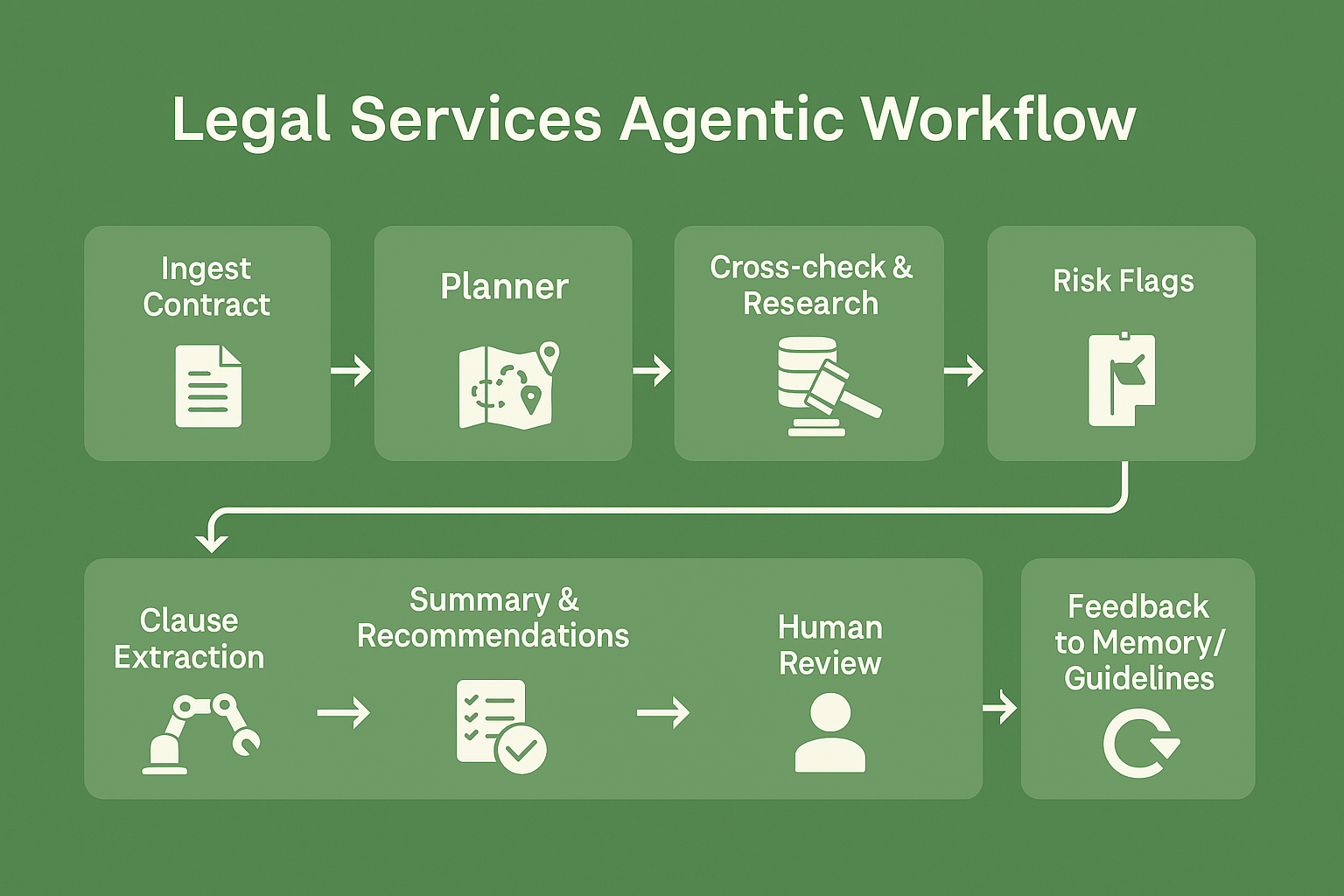
- Document Ingestion and Analysis: The agent takes a new contract (or a stack of documents) as input. Using its planner, it outlines a plan: "First, read the contract and identify key clauses (payment terms, liabilities, termination clause, etc.). Next, compare each clause against our standard library or known regulatory requirements. Then, flag any deviations or risky terms. Finally, summarise the contract and any compliance issues in a report." The executor then carries out these steps using a PDF reading tool and an LLM prompt to extract clause summaries.
- Cross-Checking and Research: For each key clause identified, the agent invokes relevant tools or databases. For instance, it might query an internal knowledge base of regulatory rules or past contracts for comparison. If a liability clause is outside the norm, the agent could use a legal database API to pull up pertinent laws or prior cases. The agent's memory stores the facts it has gathered and uses them to formulate its next actions.
- Summarisation and Reporting: Once analysis is done, the feedback loop comes into play. The agent synthesises findings and drafts a summary, such as: "Clause 5 (Non-compete) is broader than allowed under [Jurisdiction] law; recommend narrowing scope." The agent then compiles an executive summary of the entire document, highlighting risks and suggesting changes. This summary goes to the human lawyer for review.
- Validation and Learning: After the human reviews the agent's report, any feedback (corrections or additional insights) can be fed back into the agent's memory. Over time, the agent learns the firm's preferences. Importantly, throughout this process, every action the agent took was logged. This audit trail gives the legal team confidence and helps with compliance.
Leading firms and tools are already moving in this direction.18 Microsoft's Copilot Studio envisions an "automated contract review agent" that detects risky clauses and compliance issues, recommending edits to speed up legal reviews.19 By deploying an agentic workflow, a legal department can handle higher contract volumes, respond faster, and reduce human error in analysis – all while keeping human experts in control of final judgments.
Internal vs. Customer-Facing Agents
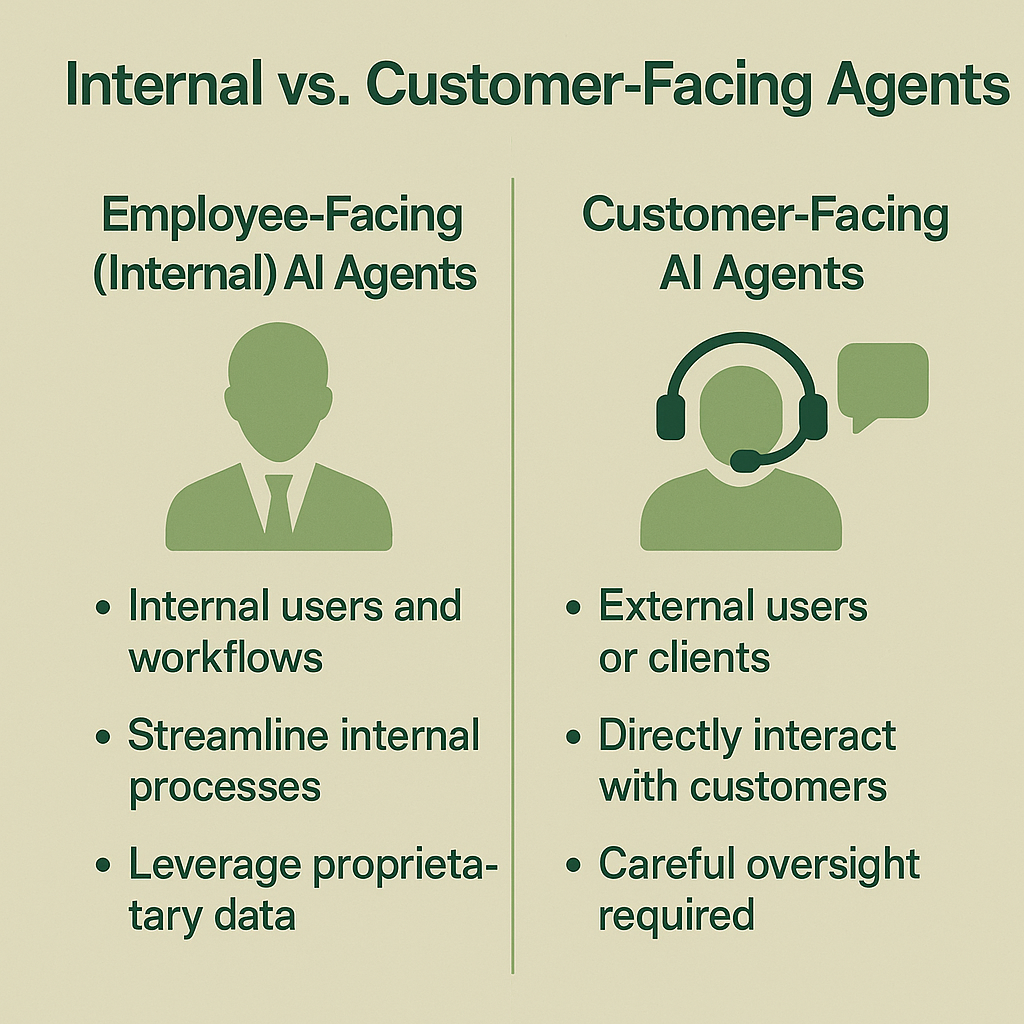
One of the core factors that could heavily inform your decision on your agentic workflow design is who the end-users are. It is important to distinguish between employee-facing agentic workflows (used within an organisation by staff) and customer-facing agents (which interact directly with clients or end-users).
Employee-Facing (Internal) AI Agents
These are agents that act as digital assistants or co-pilots for your teams. The purpose is to streamline internal workflows – from IT and HR tasks to project management and research.20 Because they operate internally, they can be deeply integrated with company systems and data. For example, an employee-facing agent in Slack might retrieve data from an internal database, generate a report, or answer an employee's question using confidential company documents.20 A well-implemented internal agent acts like a "digital teammate" that can handle busywork, from drafting status updates to triaging support tickets.20 Companies often start with internal agents because they can boost productivity and can be monitored/tweaked in a controlled environment.21
Customer-Facing AI Agents
These agents engage with external users – prospects, customers, partners – often as front-line service or sales bots. They use reasoning and tools to handle more complex queries or transactions autonomously.20 A customer-facing agent might help a user troubleshoot an issue, recommend products, or even negotiate a service plan, all in natural language. They aim to deliver a personalised experience at scale, maintaining your brand's voice and adhering to policies.20 Unlike internal agents, customer-facing ones must be extra cautious – a mistake or offensive output directly impacts customers. Therefore, businesses impose strict content filters, fallback to human agents seamlessly when needed, and enforce that the AI doesn't overstep.22
In practice, many enterprises will deploy both types. The key is recognising the different requirements: internal agents can be more experimental and leverage proprietary data heavily, whereas external agents need rock-solid reliability, user-friendly behaviour, and careful oversight. By addressing internal and external use cases, organisations can drive efficiency inside while also improving user experience outside.2223
Conclusion and Call to Action
Agentic workflows – multi-step, tool-using, goal-driven AI processes – represent a powerful evolution in how work gets done. They enable automation of complex tasks that previously required constant human intervention. Deploying AI agents in production can yield major benefits in efficiency, decision quality, and scale. However, agentic doesn't have to mean chaotic. With careful design, robust guardrails, and the right partner, you can implement agentic systems without the drama of unreliability or loss of control.
At ISx4, we specialise in helping enterprise clients implement reliable AI solutions. We bring deep expertise in AI strategy and engineering to ensure your agentic workflows are production-grade from day one. That means we emphasise auditability, building in the observability tools and logs so you can always trace what the agent did.24 It means focusing on governance – setting up the necessary permissions, human oversight points, and ethical guidelines so that your AI agents comply with your policies and industry regulations. And it means infrastructure control – deploying these agents on secure, scalable infrastructure with integration into your existing tech stack and data stores.
If you're looking to leverage agentic AI workflows in your organisation – be it to supercharge internal operations or to deliver smarter customer-facing services – ISx4 is your trusted partner to make it happen. We invite you to reach out for a strategy discussion or pilot project.
References
- What are agentic workflows? Patterns, use cases, and what to watch in 2026 – wrike.com
- What Are Agentic Workflows? Patterns, Use Cases, Examples, and More – weaviate.io
- Building Effective AI Agents – anthropic.com
- What Is an Agentic Workflow? A Guide to Autonomous AI Task Execution – smartosc.com
- What Are Agentic Workflows? Patterns, Use Cases, Examples, and More – weaviate.io
- Building Effective AI Agents – anthropic.com
- AI Agents in Production: Observability & Evaluation – microsoft.github.io
- Building Effective AI Agents – anthropic.com
- Observability in Multi-Agent LLM Systems: Telemetry Strategies for Clarity and Reliability – medium.com
- LLM Observability for AI Agents and Applications – arize.com
- AI Agents in Production: Observability & Evaluation – microsoft.github.io
- Agentic AI Explained: Workflows vs Agents – orkes.io
- What Is an Agentic Workflow? A Guide to Autonomous AI Task Execution – smartosc.com
- What are agentic workflows? Patterns, use cases, and what to watch in 2026 – wrike.com
- What Is an Agentic Workflow? A Guide to Autonomous AI Task Execution – smartosc.com
- What are agentic workflows? Patterns, use cases, and what to watch in 2026 – wrike.com
- Stanford Researchers Released AgentFlow: In-the-Flow Reinforcement Learning for Modular, Tool-Using AI Agents – marktechpost.com
- AI agents for legal document management: Applications and use cases, benefits and implementation – leewayhertz.com
- Using Copilot in Legal (Copilot Scenario Library) – adoption.microsoft.com
- Employee-facing AI Agents: A Guide to Boosting Internal Productivity – slack.com
- Transforming Retail: What to Consider Before Deploying AI Agents – mytotalretail.com
- Employee-facing AI Agents: A Guide to Boosting Internal Productivity – slack.com
- Internal Company AI: Use Cases and Best Practices – 1up.ai
- AI Agents in Production: Observability & Evaluation – microsoft.github.io